
Mold making silicone is a two-part liquid silicone rubber used to form flexible negative molds around an original model, master pattern or prototype. After the mixed material cures, the mold reproduces the master’s overall shape, fine texture, lettering, grooves and surface details, allowing materials such as resin, wax, soap, plaster, gypsum and concrete to be cast into the cavity. Review BK-A platinum-cure silicone in Shore A5 and A15 when comparing material options for a mold-making project.
Choosing the right type requires more than selecting a soft or firm Shore A hardness. Cure chemistry, casting formulation, mold geometry, wall thickness, undercuts, casting weight, dimensional priorities, production frequency and workspace contamination can all change the result. A soft silicone may release a detailed figurine easily but distort under a heavy pour, while a firmer mold may hold its shape better but place excessive stress on fragile parts or narrow openings.
The practical selection order
Begin with the casting material and master surface, then assess mold geometry and support. Only after those points are clear should hardness, viscosity, tear strength, working time and cure system be compared.
- Identify the complete casting formulation and process temperature.
- Record the master material, coating, sealer and release agent.
- Mark undercuts, deep cavities, thin edges and expected casting weight.
- Decide whether the rubber must support itself or use a mother mold.
- Confirm production volume, dimensional needs, documents and validation tests.
What Are the Main Types of Mold Making Silicone?
Most liquid silicone materials used for mold making fall into two cure families: platinum-catalyzed addition-cure silicone and tin-catalyzed condensation-cure silicone. Both begin as pourable or spreadable components and cure into flexible rubber, but their reaction chemistry affects dimensional behavior, contamination sensitivity, processing and application fit.
Cure type is an important first filter, but it is not a complete product specification. Two silicones within the same cure family may have different hardness, viscosity, tear resistance, elongation, working time and dimensional behavior. The exact grade must therefore be reviewed alongside the real casting and mold-making process.
| Selection Area | Platinum Addition Cure | Tin Condensation Cure |
|---|---|---|
| Typical starting point | Detailed molds, dimensional priorities, repeated production and projects requiring specific supporting documents | General molding, decorative casting, prototypes and applications with broader dimensional tolerance |
| Main process concern | Possible cure inhibition from sulfur, latex, tin residues, certain amines, coatings or incompletely cured printed masters | Dimensional change and long-term behavior must be checked against the project tolerance and storage period |
| Approval evidence | Exact-grade TDS and SDS, contact cure test, casting compatibility check and representative mold trial | Exact-grade TDS and SDS, compatibility review and a trial covering expected use, dimensions and storage |
A deeper cure-chemistry comparison is available in Platinum Silicone vs Tin Silicone. For this guide, the more important question is how each material fits the casting medium, mold structure and production conditions.
How BK-A05 and BK-A15 Fit Different Mold Structures
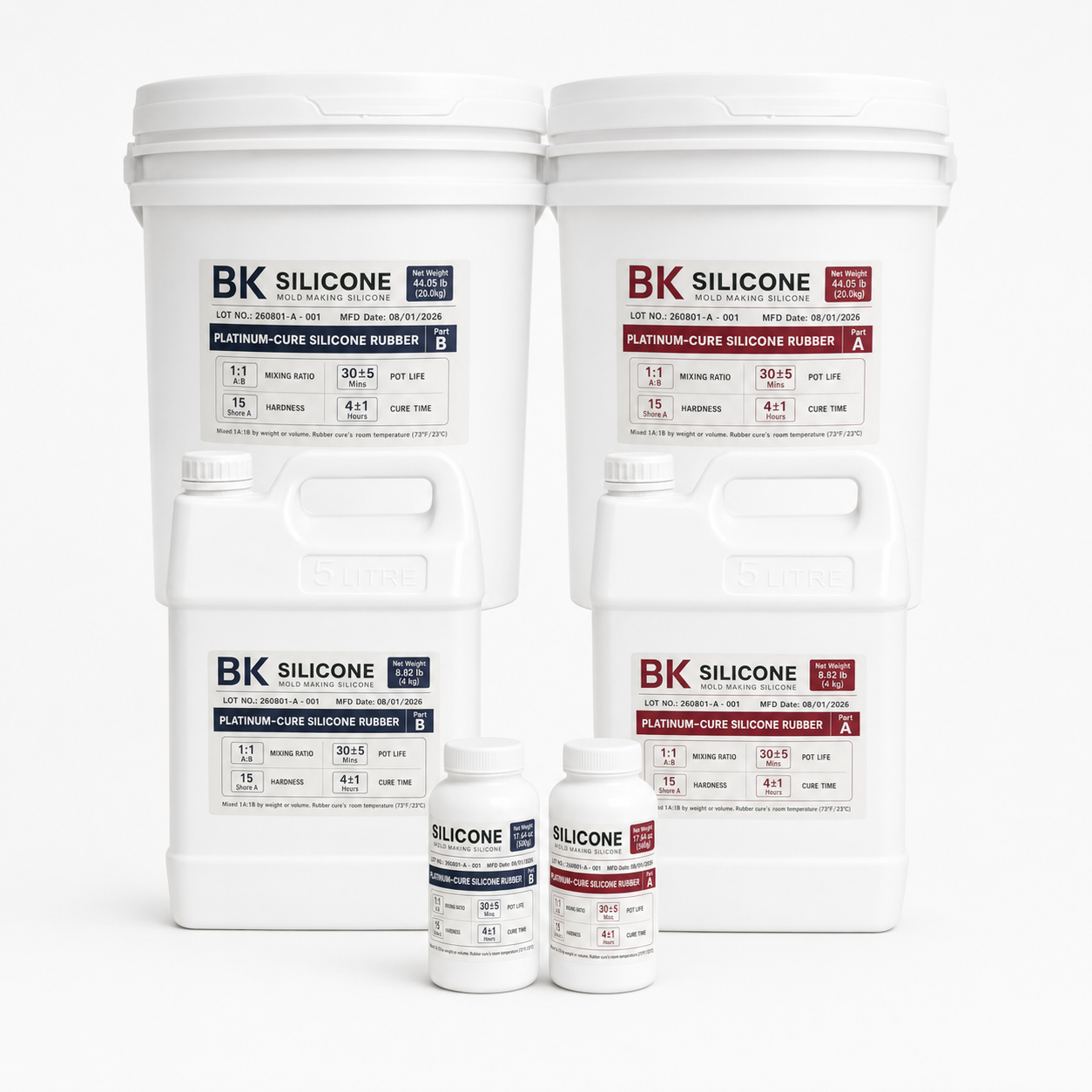
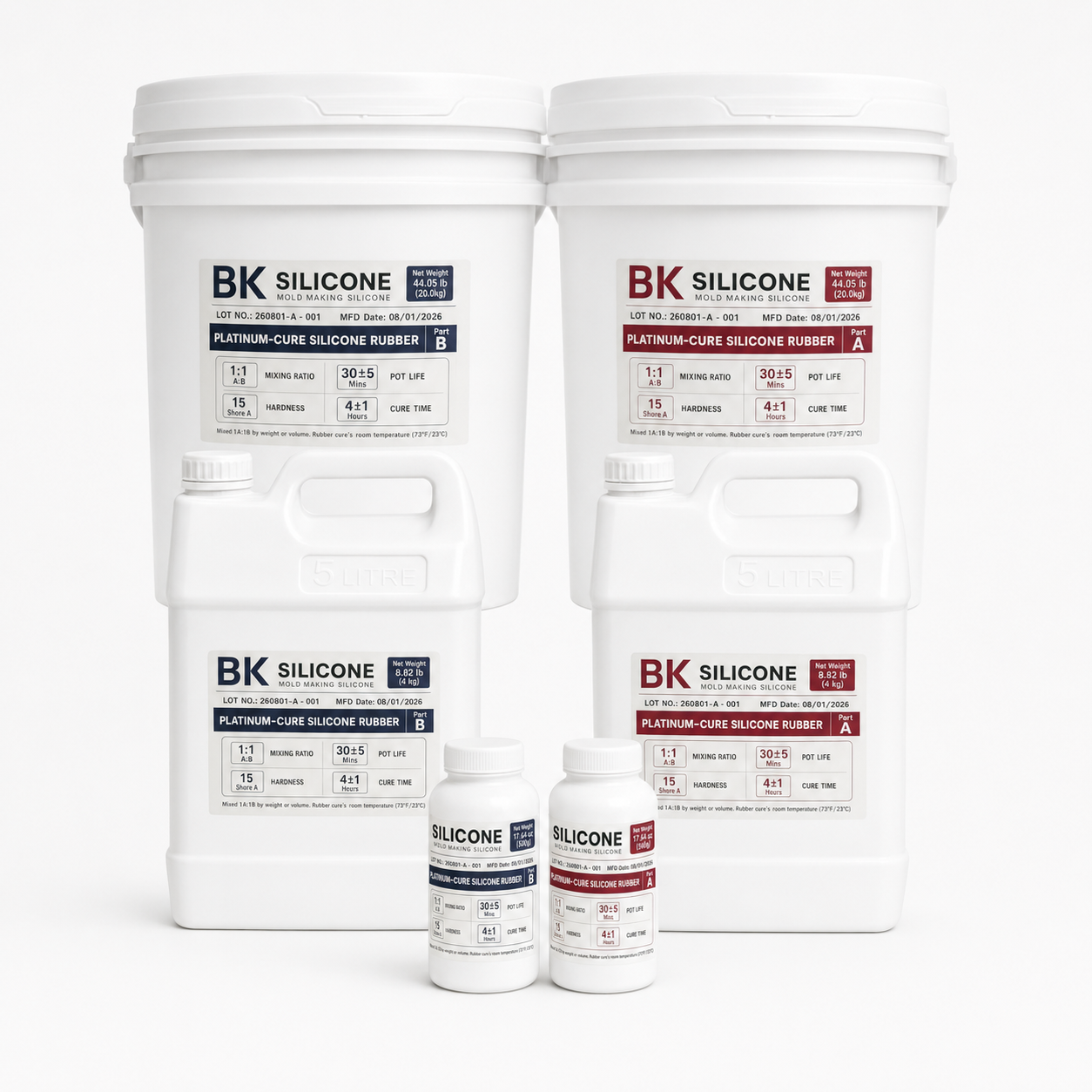
The BK-A Series provides two platinum-cure starting directions. BK-A05 cures to approximately Shore A 5 and offers greater softness and elongation, while BK-A15 cures to approximately Shore A 15 and provides more structure and higher reported tear strength. These differences help narrow the starting grade, but the final decision still depends on geometry, wall thickness, casting weight and external support.
BK-A05: Softer Release Direction
BK-A05 is the more flexible starting point when the mold must stretch around complex undercuts, narrow openings or fragile castings. It can reduce demolding force where a firmer rubber might place excessive stress on the finished part.
The mold may require a stable base, thicker walls or a fitted mother mold when the cavity is tall, wide or filled with a heavy material. Softness should not be used as a substitute for structural support.
BK-A15: More Structured Direction
BK-A15 is the more structured starting point when mold walls need additional body, the casting places greater load on the cavity or the mold will be handled repeatedly. Higher firmness can help the mold retain its intended shape during filling and movement.
A firmer mold can require more release force around deep undercuts or narrow necks. Split lines, controlled cuts, wall design and demolding direction must be resolved before choosing firmness alone.
How to Choose Mold Making Silicone by Casting Material
The material poured into the mold can create heat, moisture, chemical exposure, abrasion and mechanical load. Those conditions affect cure compatibility, surface quality, release force, mold wear and dimensional stability. Selection should therefore begin with the complete formulation rather than a broad description such as “resin” or “concrete.”
Additives matter as much as the base material. Hardeners, pigments, fillers, fragrances, botanical ingredients, aggregate, release agents and cleaning chemicals can change how the silicone behaves. A representative trial should use the same materials and process planned for production.
| Casting Material | Main Selection Risk | Useful Starting Direction | Confirm Before Ordering |
|---|---|---|---|
| Wax and candles | Pour temperature, fragrance, dye, repeated heating, narrow openings and tall unsupported walls | Flexible rubber for detailed release, with structural support where the mold may bow | Complete wax formula, maximum pour temperature, cooling time and demolding method |
| Soap | Fragrance, pigment, botanical material, alkaline ingredients, cooling and cleaning | Flexibility matched to cavity depth, detail and the fragility of the finished bar | Full formulation, intended temperature and the actual washing and storage routine |
| Epoxy or polyurethane resin | Hardeners, amines, cure heat, pigments, fillers, surface sticking and master compatibility | Compatibility-tested platinum silicone where detail and dimensional control matter | Exact resin system, hardener, additives, casting mass and master preparation |
| Plaster and gypsum | Fragile castings, water content, drying, narrow channels and damaged sharp details | Flexible mold with sufficient support to remain stable while the slurry settles | Water ratio, casting weight, drying time, release method and cleaning process |
| Concrete and cement | Weight, aggregate, abrasion, wall pressure, lifting and higher demolding force | Structured mold or flexible detail skin supported by a fitted mother mold | Aggregate, pigment, release agent, mold wall, shell and handling method |
| Food-contact applications | Document scope, contact conditions, destination market and production hygiene | Exact grade supported by documents relevant to the intended application | Food type, temperature, contact time, local requirements and finished-article obligations |
Wax and Soap: Balance Easy Release with Wall Support
Wax molds often need flexibility around decorative textures, narrow necks and complex shapes. Fragrance oils, dyes, additives and repeated warm pours should be included in the trial rather than testing plain wax alone. Tall candle molds may need external support even when a softer silicone improves demolding.
Soap molds can face similar release demands, but the formulation may also include pigments, fragrance, botanical particles or alkaline ingredients. The complete soap formula, cooling process and cleaning routine should be tested because residue and repeated washing can affect the mold surface over time.
Resin: Confirm Both Chemical Compatibility and Cure Heat
Resin is not one uniform casting category. Epoxy, polyurethane, polyester, acrylic and mineral-filled systems use different hardeners, pigments, solvents and cure reactions. Large resin pours can also generate more heat than small decorative pieces, changing both the casting process and the stress placed on the mold.
The master surface is especially important for resin projects. Incompletely cured printed masters, unknown sealers, adhesives or release agents can interfere with platinum silicone or leave surface defects. A successful test on a clean cup does not prove compatibility with the prepared master.
Plaster and Concrete: Do Not Use Hardness as the Only Support
Plaster and gypsum castings can be fragile during demolding, making flexibility useful around fine edges and relief details. At the same time, the water-rich slurry requires the cavity to remain stable while the material settles. A mold that is easy to peel but poorly supported may produce distorted walls or inconsistent dimensions.
Concrete adds greater weight, abrasion and pressure against the mold walls. A fitted mother mold, rigid base, controlled filling sequence and defined lifting method can provide more reliable support than simply selecting a firmer rubber. Aggregate size, pigment, release agent and cleaning tools should all be included in the sample program.
Match the Silicone to the Mold Design
Mold geometry determines how uncured silicone reaches the master, where air may become trapped and how far the cured rubber must stretch during release. The visible outer dimensions are not enough. Hidden undercuts, narrow internal sections, sharp transitions and thin edges often create the highest stress.
Open-Face Molds
Plaques, tiles, coasters and shallow reliefs usually create limited release stress. Broad surfaces still need a flat base or backing so the cavity does not sag or twist during filling and storage.
Deep Block Molds
Deep cavities create longer flow paths and increase the risk of trapped air. The mold also stretches farther during demolding, so pouring direction, vents, wall thickness and working time should be considered together.
Split and Multi-Part Molds
Severe undercuts may be handled more reliably with a controlled split, planned cut or multi-part mold. Increasing softness alone can create excessive cavity movement and inconsistent parting lines.
Brush-On and Supported Molds
A flexible silicone skin can capture complex detail while a rigid mother mold preserves the overall form. The shell must fit the rubber accurately and support it without crushing thin features.
Undercuts and Narrow Openings
An undercut locks part of the casting behind a wider section of the mold. The rubber must deform temporarily so the casting can pass through without tearing the mold or breaking the part. Softer silicone can reduce release force, but severe undercuts may still require a split line, removable insert or multi-part construction.
Fine Detail, Thin Edges and Tear Points
Fine lettering, textures and narrow grooves depend on good surface contact, controlled flow and limited trapped air. Dust, porosity, oil or incomplete sealing on the master can damage reproduction even when the silicone has suitable viscosity. Thin lips and sharp corners should be reinforced or redesigned because a small cut can grow during repeated flexing.
Large Molds and Heavy Castings
Large molds need a complete structural plan covering rubber thickness, casting weight, shell fit, lifting points, filling pressure and drainage. A firmer unsupported mold may still bow under a heavy pour. A softer detail layer with a correctly fitted shell can sometimes provide better shape control and easier release.
Hardness, Viscosity, Tear Strength and Processing
Technical properties answer different questions. Hardness indicates resistance to indentation, viscosity describes how the uncured material flows and tear strength describes resistance to the growth of an existing cut or notch. None of these values should be treated as a complete measure of mold quality.
| Property | What It Influences | Risk When Chosen in Isolation |
|---|---|---|
| Shore A hardness | Flexibility, self-support, release force and resistance to cavity movement | A soft mold may distort; a firm mold may become difficult to release around undercuts |
| Viscosity | Flow into fine detail, narrow cavities, brush application and air movement | Low viscosity does not guarantee bubble-free molds; high viscosity may trap air without controlled application |
| Tear strength | Resistance to tear growth at cuts, thin edges and stressed release areas | Strong material can still fail where the mold contains sharp transitions or poor cut design |
| Working time | Available time for mixing, degassing, pouring and reaching deep features | A batch may thicken before the mold is filled if size, temperature and preparation are not considered |
| Dimensional behavior | Repeatability, part fit and changes across long or critical dimensions | Material stability cannot compensate for a moving mold box, poor shell fit or unsupported walls |
Hardness Controls Both Release and Support
Lower hardness generally provides more flexibility, which can help release complex undercuts and protect fragile castings. Excessive softness may allow the cavity to stretch, bow or change shape under a tall or heavy casting. Wall thickness and mother-mold support should be reviewed at the same time.
Higher hardness adds body and can improve handling where the mold must support itself. It may also increase release stress around deep cavities, thin projections or narrow openings. A controlled split is often more reliable than forcing a highly locked casting out of a firmer one-piece mold.
Viscosity Must Match the Application Method
Lower-viscosity material can reach fine textures and narrow areas more easily, but flow alone does not remove every bubble. Batch size, mixing speed, temperature, pouring path and vacuum availability still affect the surface result. Deep cavities and critical details may require controlled degassing even when the material has natural air-release behavior.
Higher-viscosity silicone may be useful in brush-on or vertical applications where the material must remain on the surface. It can also bridge over fine recesses or retain air if the first detail coat is not applied carefully. The planned mold-making method should therefore define the useful viscosity range.
Prevent Cure Inhibition Before Full Production
Platinum-cure inhibition can leave the silicone tacky, soft or uncured where contamination blocks the reaction. Possible sources include sulfur-containing clay, latex, tin-cure residue, certain amines, incompletely cured LCD or DLP printed resin, unknown sealers, adhesives, release agents and shared tools.
Paint, sealer or adhesive chemistry is not recorded and no contact cure test has been completed.
Cups, brushes, vacuum equipment or work surfaces move between cure systems without controlled cleaning.
Washing, post-curing and sealing records are missing for an LCD or DLP resin print.
The base resin is listed, but hardener, filler, pigment, release agent and cure conditions remain unknown.
The Shore A value has been selected without reviewing wall thickness, undercuts, support and casting weight.
Approval relies only on a data sheet, without making a mold from the intended master and casting formulation.
A useful comparison test: cure one small sample in a verified clean cup and place another sample against the prepared master. If the cup sample cures but the contact patch remains tacky, the master, coating or release layer is the likely source. If both samples fail, mixing, proportioning, storage, temperature or wider contamination should be checked.
How to Choose the Right Mold Making Silicone
A reliable selection process moves from the application to the material, rather than starting with a product number. The following sequence helps procurement and production teams compare grades using the same project information and acceptance criteria.
Define the Complete Casting Process
Record the base casting material, hardener, pigment, filler, fragrance, aggregate, release agent, casting mass and maximum process temperature. Changes in formulation should be treated as process changes rather than assumed to be automatically compatible.
Document the Master and Contact Surfaces
Identify the master material, manufacturing method, post-curing process, paint, sealer, adhesive, clay and release layer. Where surface chemistry is uncertain, complete a small contact cure test before mixing a production batch.
Classify Geometry and Mold Support
Mark cavity depth, undercuts, narrow openings, thin lips, critical details, parting lines and expected casting weight. Define the mold wall, flange, gate, vent, insert, controlled cut and mother mold before selecting hardness.
Set Production and Dimensional Priorities
State whether the mold is intended for a prototype, pilot batch, repeat order or ongoing production. Identify the dimensions that affect assembly, appearance or function, together with inspection methods, cleaning, storage and replacement criteria.
Confirm Workshop Capability
Review weighing accuracy, batch size, mixing equipment, vacuum availability, pouring or brushing method, room temperature and tool separation. The selected material must fit the actual workshop process rather than an ideal laboratory procedure.
Approve Through a Representative Trial
Make a small mold using the intended master preparation, casting formulation and production tools. Check full cure, detail reproduction, surface finish, release force, shape recovery, critical dimensions, cleaning behavior and early tear growth before committing to regular production.
Production Cycles and Mold Life
A fixed number of casting cycles should not be promised without project evidence. Heat, casting chemistry, aggregate, release agents, undercut stress, cleaning tools, mold design and storage can all shorten or extend usable life. A realistic trial tracks the complete cycle from filling and curing through demolding, cleaning, inspection and storage.
The trial should use normal production handling rather than an unusually gentle laboratory release. Written observations can record surface change, tear growth, distortion, release behavior, cleaning time and dimensional variation. This creates a practical replacement standard without relying on an unsupported universal cycle claim.
Documents to Request Before Approval
A technical data sheet normally provides typical processing and physical-property information, while a safety data sheet covers handling, hazards, storage, first aid and disposal. Typical values are useful for comparison, but they are not guaranteed results for every mold geometry and casting process.
Basic Product Documents
- Current TDS for the exact supplied grade
- Current SDS in the required language
- Storage and opened-container guidance
- Known exclusions, limitations or processing warnings
Application-Specific Evidence
- Available application or food-contact reports
- Compatibility guidance for the master surface
- Compatibility guidance for the casting medium
- Sample recommendation and acceptance criteria
Food-contact documentation must be checked against the exact grade, tested conditions, food type, contact time, process temperature, destination market and finished article. A general product description does not automatically establish suitability for every food-contact application.
Information to Send with a Material Inquiry
Clear project data allows a material recommendation to address the complete process rather than only a requested hardness.
- Finished part and complete casting formulation
- Master material, coating and manufacturing method
- Overall dimensions, cavity depth and casting weight
- Undercuts, narrow openings and fragile features
- Mold type, wall thickness and support shell
- Production rhythm, demolding and cleaning method
- Critical dimensions and acceptance criteria
- Required TDS, SDS and supporting reports
Frequently Asked Questions
Prepare a Material Review with Real Project Data
A useful recommendation begins with the casting formulation, master surface, mold dimensions, undercuts, casting weight, support method and production conditions. These details allow BKSilicone to compare a softer release-focused direction with a more structured mold direction and identify the documents and tests required before approval.
Include photos or drawings, critical dimensions, intended casting material, known contamination risks, expected production rhythm and document requirements. Pricing, MOQ, lead time, mold life, compliance scope and final performance remain subject to the selected grade and project confirmation.
Send Project DetailsThe right mold making silicone is the grade that matches the casting chemistry, mold structure, production conditions and required evidence—not simply the softest, hardest or lowest-cost option.