
If you are buying a soap-making solution, start with one distinction: liquid silicone is a material for making a mold around your own master pattern, while a ready-made silicone soap mold is a finished tool that you can fill with soap immediately. A third route is a custom mold, where you supply a shape, drawing, sample, or brand idea and a mold maker develops the finished tool for you. Choosing between these routes depends on whether you want to make the mold, use a proven shape, or develop a repeatable shape that is specific to your business.
The three routes for soap makers
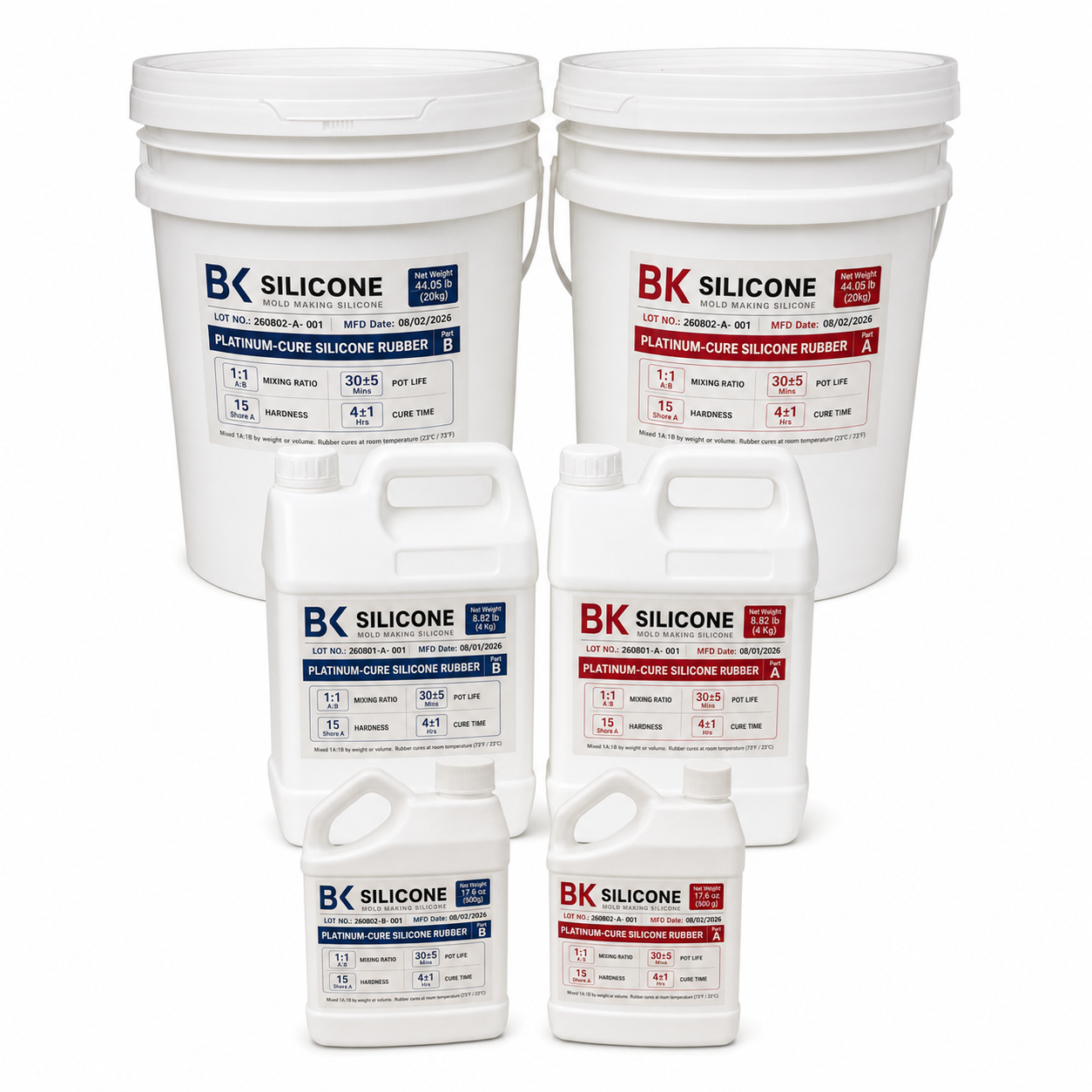
Liquid silicone is useful when the soap shape already exists as a master. That master can be a model, carved pattern, prototype, or another object prepared for molding. You mix the two parts, pour around the master, allow the material to cure, remove the master, and then use the cured mold for soap production. This route gives you control over the pattern and is suited to makers who need to reproduce a shape that is not available as a standard mold.
For BK-A05 and BK-A15, the confirmed mixing ratio is 1:1 by weight. The standard working time is 30 ± 5 minutes at 23°C (73°F), and the standard cure time is 4 ± 1 hours at 23°C (73°F). These are material working and cure references; they are not soap-making times, demold guarantees, or production lead times. The typical hardness values are measured after 24 hours of curing at 23°C (73°F): BK-A05 is Shore A 5 and BK-A15 is Shore A 15.
BK-A05 is intended for deep undercuts, fine detail, and complex demolding. BK-A15 is intended for general or larger molds and uses where greater dimensional stability is wanted. The right choice still depends on the geometry, release direction, master surface, and the soap process. A small contact test is recommended before committing a full mold, especially where the master has sulfur clay, latex gloves, tin-cure silicone residue, amines, some epoxy curing agents, or an unsealed SLA/LCD/DLP resin surface. These materials may inhibit platinum-cure silicone and cause tackiness or incomplete curing.
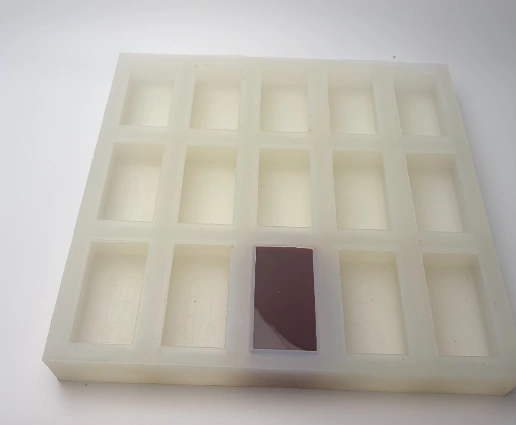
Ready-made silicone soap molds are different. They are already formed, so the immediate question is whether the cavity shape, size, wall form, and release behavior fit your soap design. You do not need to build a master or pour liquid silicone around it. This can be the practical route for a repeatable product, a seasonal collection, testing a design, or a small range of standard shapes. Before buying, confirm that the mold is a real silicone mold intended for the stated use. A product image alone does not prove the material, dimensions, capacity, or hardness.
The photograph above shows a thick-wall silicone soap mold with three rows of five cavities. When reviewing a similar design, check the usable cavity dimensions and the support it needs during filling. Cavity count alone does not tell you how much soap each bar will hold.
Custom soap molds form the third route. They are useful when a standard mold does not express your logo, product silhouette, collection theme, or required cavity arrangement. The process normally starts with a brief: the target shape, master or drawing, approximate dimensions, number and arrangement of cavities, demolding direction, and the soap material or process. The maker then evaluates the geometry and confirms the workable design before sampling or production. Do not treat the material cure time as a promised mold-production schedule. Sampling and production timing must be confirmed for the actual order.
For a small soap studio, the decision can also follow the stage of the product. During exploration, a ready-made mold can help you compare fragrance, color, finish, and packaging without adding mold-making work. Once a shape proves useful, a custom version can make the cavity arrangement or branding more consistent. If the shape comes from your own sculpture or prototype, liquid silicone can preserve that source shape for repeated casting. Keeping these stages separate helps avoid buying a raw material when you need a finished tool, or ordering a standard tool when the product depends on a distinctive master.
Think about handling as well as appearance. A mold with deep detail may need a release plan that protects delicate soap edges. Closely spaced cavities may affect pouring and cleaning. A large or flexible mold may need support during filling and storage. These are design questions to confirm with the actual geometry, rather than claims that can be inferred from a product name or a stock photograph. When the intended soap, colorant, fragrance, or coating is unusual, include it in the small test and keep the result with the project record.

Side-by-side comparison
| Question | Liquid silicone for mold making | Ready-made silicone soap mold | Custom finished mold |
|---|---|---|---|
| What you buy | Two-part molding material | A formed mold ready for use | A mold developed for your design |
| Best for | Reproducing your own master | Using a known or standard cavity | A logo, special shape, or planned collection |
| Main work | Prepare, mix, pour, cure, and demold | Select, check, wash if needed, and use | Share requirements, review design, and confirm sample |
| Shape control | High, based on the master | Limited to the listed cavity | High, subject to design feasibility |
| Main risk | Incompatible master or poor mixing | Wrong dimensions or construction | Unclear brief or unconfirmed geometry |
| Material reference | BK-A05 or BK-A15, 1:1 by weight | Confirm the actual mold material | Confirm the actual production material |
| Timing reference | 30 ± 5 min working; 4 ± 1 h cure at 23°C (73°F) | Use the supplier’s confirmed instructions | Timing is order-specific and must be confirmed |
Five steps to choose
1. Decide what you need to receive. If you want raw material and already have a master, start with liquid silicone. If you want to pour soap soon, look for a ready-made mold. If the shape is unique, prepare a custom brief.
2. Check the geometry before the marketing name. Note undercuts, narrow openings, fine texture, draft, cavity spacing, and how the soap will be released. Deep detail and complex release may point toward a softer grade such as BK-A05; general or larger molds may point toward BK-A15, subject to review.
3. Confirm the process conditions. For liquid material, use the confirmed 1:1 weight ratio and keep the 30 ± 5 minute working reference and 4 ± 1 hour cure reference tied to 23°C (73°F). Do not copy these figures into a soap recipe or treat them as an order deadline.
4. Test the contact surfaces. Make a small compatibility test with the master or any coating. Pay special attention to sulfur clay, latex, old tin-cure silicone, amines, some epoxy systems, and unsealed resin prints. A test can reveal inhibition before a complete pour is lost.
5. Request the missing facts in writing. Ask for the actual material, dimensions, cavity arrangement, capacity if relevant, hardness when relevant, image-to-product match, sample method, and order-specific timing. Keep the request tied to the exact mold or material grade.
Common misunderstandings
“Liquid silicone is a finished soap mold.” It is a molding material. It becomes a mold only after it is mixed, poured around a suitable master, cured, and demolded.
“Four hours means my soap can be unmolded in four hours.” The 4 ± 1 hour figure is a material cure reference at 23°C (73°F). It does not describe soap setting, final mold handling, or a production promise.
“A softer material is always better.” Softness can help with undercuts, but geometry, detail, support, and release method also matter. Select by the whole process.
“A photo proves every specification.” Count the cavities and inspect the shape, then request the specifications for the exact mold you plan to order. A photograph cannot tell you its capacity or silicone hardness.
“A custom mold is just a standard mold with a new label.” Custom work needs a defined design and feasibility review. The result depends on the master, geometry, release direction, and confirmed production scope.
Buyer checklist
- I know whether I need liquid material, a ready-made mold, or a custom mold.
- My master, drawing, or sample is identified and suitable for the intended route.
- I have checked undercuts, detail, openings, cavity spacing, and release direction.
- For BK-A05 or BK-A15, I will mix 1:1 by weight.
- I understand that 30 ± 5 minutes and 4 ± 1 hours are 23°C (73°F) material references.
- I will not use cure time as a soap time or production lead time.
- I will run a small contact test where inhibition is possible.
- I have requested exact dimensions and other missing facts for the actual mold.
- I have separated an appearance reference from confirmed product specifications.
- I have a written brief for any logo or custom shape.
For help choosing a liquid silicone grade, checking a ready-made mold, or discussing a custom soap mold, send the master or design information, intended soap process, approximate size, cavity plan, and target quantity. We can then review the suitable route and the facts that still need confirmation. Discuss your soap-mold project
Material reference: Explore liquid silicone for soap molds · Ready-made molds: Browse silicone soap molds · Custom route: Learn about custom silicone molds