
Platinum Silicone for Mold Making is a strong option when a project needs accurate detail reproduction, controlled mold dimensions, clean curing, and flexible demolding. The material is not automatically the best choice for every master or every casting process. A useful selection starts with the finished master, casting chemistry, mold geometry, expected load, release path, and production rhythm. Review BK-A platinum-cure silicone in Shore A5 and A15 when comparing material options for a mold-making project.
Selection should narrow to four practical questions: whether platinum-cure silicone fits the project, which risks need to be tested first, whether BK-A05 or BK-A15 is the better starting direction, and what information should be prepared before requesting a sample or production order.
Review the actual resin, clay, primer, paint, sealer, adhesive, and release product that will contact the silicone.
Mark cavity depth, undercuts, thin edges, parting lines, openings, vents, and any area that must flex during release.
Record casting chemistry, additives, weight, process heat, batch size, and whether an outer support shell will carry the load.
Test cure, detail filling, release, surface quality, and the highest-stress feature before scale-up.
When Platinum Silicone for Mold Making Is a Good Fit
Addition-cure silicone is most useful when its material advantages match the mold structure. Low shrinkage can support dimensional control, but the master, mold box, support shell, cure conditions, and casting material still influence the final part. A stable elastomer cannot compensate for a warped master or an unsupported cavity wall.
Flow behavior matters around lettering, engraved details, narrow channels, and deep recesses. The practical question is not simply whether a material has low viscosity. The mixing method, pour direction, venting, material temperature, and available degassing process determine whether those details actually fill without trapped air.
Tear resistance becomes important where the mold must stretch around an undercut, thin lip, planned cut, or narrow opening. A strong rubber can still fail if the part is mechanically locked or if stress concentrates at a sharp notch. Release geometry should be reviewed before a higher tear value is treated as the solution.
Cure cleanliness is equally important. Platinum catalysts can be affected by incompatible surface chemistry, so an apparently dry or hard master may still create local inhibition if sulfur, amines, tin residue, or incompletely cured coatings remain at the contact surface.
Projects that usually deserve a platinum-silicone review
- Fine texture, lettering, or small surface detail
- Moderate undercuts that require controlled mold flexing
- Repeat in-house mold production with defined process steps
- Resin or coated masters that can be compatibility-tested
- Applications that require grade-specific technical documents
- Projects where the sample can reproduce the real casting conditions
Best-Fit Applications and What Changes the Decision
The application name is only the first filter. Two candle molds may need different silicone behavior because the cavity depth, wax formulation, wall support, and release opening are different. The same principle applies to soap, resin, plaster, concrete, food-contact work, and detailed decorative parts.
Candle Molds
Decorative candle molds may contain deep cavities, petals, lettering, narrow tips, or textured surfaces. The silicone needs enough movement to release those details without letting tall walls bulge during pouring. A fitted outer shell can separate the flexibility needed for demolding from the stiffness needed for shape control.
Use the intended wax blend during validation. Fragrance oils, pigments, additives, and pouring conditions can change surface behavior, so a clean silicone cure by itself does not prove that the complete candle process is ready for repeat production.
Soap Molds
Simple bar molds place less demand on release movement than deep logos or complex artisan shapes. Multi-cavity trays introduce another issue: thin bridges and dividers can flex during handling. A firmer direction may stabilize a tray, while a softer direction may help a deep logo or reverse detail release with less force.
Test the actual soap base and relevant additives. Salts, fragrances, botanicals, colorants, cavity count, and cleaning practice belong in the sample plan rather than being treated as interchangeable details.
Resin Casting Molds
Epoxy, polyurethane, polyester, and UV-curing systems can create different heat, surface, and compatibility conditions. Rigid resin castings also place more of the release movement on the silicone, which makes deep reverse angles and narrow openings important design checks.
Where the resin system itself is the main uncertainty, use the dedicated resin casting with silicone molds guide for process planning. For this material-selection decision, record the exact resin chemistry, fillers, pigments, release agent, master coating, and process heat before approving a grade.
Plaster, Gypsum, and Aroma Stone
These castings need clean edge transfer and dependable mold support. The wet load can move broad or tall walls, while fragile corners can be damaged by an aggressive release path. Draft, corner radius, pour orientation, and a stable cradle are often more important than simply choosing the softest material.
A representative trial should check edge completeness, trapped air, wall movement, and how the operator grips the mold during release.
Concrete and Cement-Based Casting
Concrete adds casting weight, aggregate contact, and more demanding handling. Small decorative pieces may work with a flexible one-piece mold, while larger parts often need a reinforced cradle or segmented support shell. A very soft cavity can distort under load; excessive firmness can make a difficult release even harder.
Record mix design, aggregate size, part mass, vibration method, lifting method, and planned cleaning. The trial should reproduce the intended production mix as closely as practical.
Food-Contact Applications
Food-contact work requires grade-specific document review rather than a general “food grade” assumption. Food type, contact time, process temperature, repeated-use conditions, cleaning method, and destination market should be defined before available reports are treated as relevant.
Chocolate, fondant, ice, and baked products do not create identical exposure conditions. Product documentation can support the review, but the final commercial use may still require market-specific assessment.
Fine-Detail Replication
Figurines, architectural ornaments, jewelry masters, textured panels, and character models place more emphasis on surface wetting and controlled release. Small lettering and narrow grooves need dependable filling, while thin projections and reverse features need a release path that does not concentrate force at one edge.
The softest grade is not automatically the best choice. Excessive wall movement can reduce dimensional consistency, especially when the mold lacks a fitted holder or support shell.
Cure Risks to Check Before a Full Mold Pour
Platinum-catalyzed systems can be sensitive to materials that interfere with the cure reaction. If the finished master contains uncertain chemistry, start with a small contact test. The test should include the final primer, paint, filler, sealer, adhesive, repair compound, and release product—not an unfinished substitute surface.
Sulfur, Latex, Tin Residue, and Shared Tools
Sulfur may appear in some modeling clays and rubber compounds. Natural latex and residue from condensation-cure silicone can also create compatibility problems. Contamination can transfer from old molds, mixing containers, stirrers, gloves, benches, or porous master surfaces.
A surface that feels dry is not proof of compatibility. Residue can remain inside pores, scratches, previous coatings, or hard-to-clean corners. Dedicated containers and controlled work surfaces reduce uncertainty, but a test cure provides the most direct evidence for the finished master.
3D-Printed Resin Masters
SLA, DLP, and similar resin prints need a documented preparation process. Washing, post-curing, sanding, priming, and sealing can vary by printer, resin, pigment, and finishing system. A print that feels fully hardened can still create local inhibition at the silicone contact surface.
BK-A05 and BK-A15 can be considered as starting directions within the BK-A Series, but no web-page statement should be extended automatically to every printed resin or coating. Validate the actual finished master before a full pour.
Six Red Flags Before Scale-Up
Test the final master surface and all coatings that will contact the silicone.
Reproduce the smallest groove, deepest undercut, thinnest lip, or hardest-to-fill section.
Use the intended casting material and check release, surface quality, wall movement, cleaning, and visible stress.
Choose the Grade by Mold Geometry and Failure Risk
Geometry controls how the liquid fills, how the cured mold carries load, and how the finished part escapes. The first useful question is not “Which Shore A is best?” but “Where is this mold most likely to fail?” Filling problems, wall movement, mechanical locking, and thin-edge damage lead to different material and design priorities.
Flat and Shallow Forms
Prioritize surface wetting and dimensional stability. Broad unsupported areas may sag during handling, so a rigid backing plate can protect flatness without asking the silicone to provide all structural support.
Deep Cavities
Long flow paths can trap air near the bottom, while tall walls increase release friction and liquid pressure. Review pour direction, vents, wall thickness, opening size, and whether a holder or shell is needed.
Undercuts and Reverse Features
Moderate undercuts can benefit from controlled mold flexing. A severe mechanical lock may require a planned cut, removable core, split mold, or revised parting line instead of a softer grade.
Fine Details and Thin Edges
The uncured silicone must reach small lettering and narrow fins, then the cured section must survive trimming and release. Local radius, added thickness, grip points, and gradual peeling can protect vulnerable edges.
Large or Heavy Molds
Large cavities carry the mold’s own weight plus the casting load. A mother mold, cradle, or segmented support shell often provides more direct dimensional control than increasing hardness alone.
Multi-Part Molds
Multiple sections can solve difficult release directions, but each joint adds alignment, leakage, flash, and handling requirements. Keys, flanges, clamps, gates, and opening sequence should be planned before material approval.
Use Material Properties to Solve the Identified Risk
Use flow behavior to answer whether the material can wet fine detail and reach narrow areas with the available mixing, pouring, venting, and degassing process.
Use hardness to balance cavity movement and wall stability. Softer is useful only when the release path needs it; firmer is useful only when it does not create excessive demolding force.
Use tear behavior to review thin lips, cuts, notches, and repeatedly stressed edges. Mechanical locking still requires a geometry solution.
For detailed property definitions, comparison logic, and test-method cautions, see Silicone for Mold Making: Hardness, Viscosity and Tear Strength Explained. Compare those values against the real wall thickness, casting load, opening size, undercuts, support method, and release path before approving a grade.
BK-A05 vs BK-A15: Which Direction Should You Test First?
BK-A05 and BK-A15 should be treated as two starting directions, not as “good” and “better” versions of the same material. The first sample should follow the dominant failure risk: release movement and deep undercuts point one way; wall support and repeated edge stress point another.
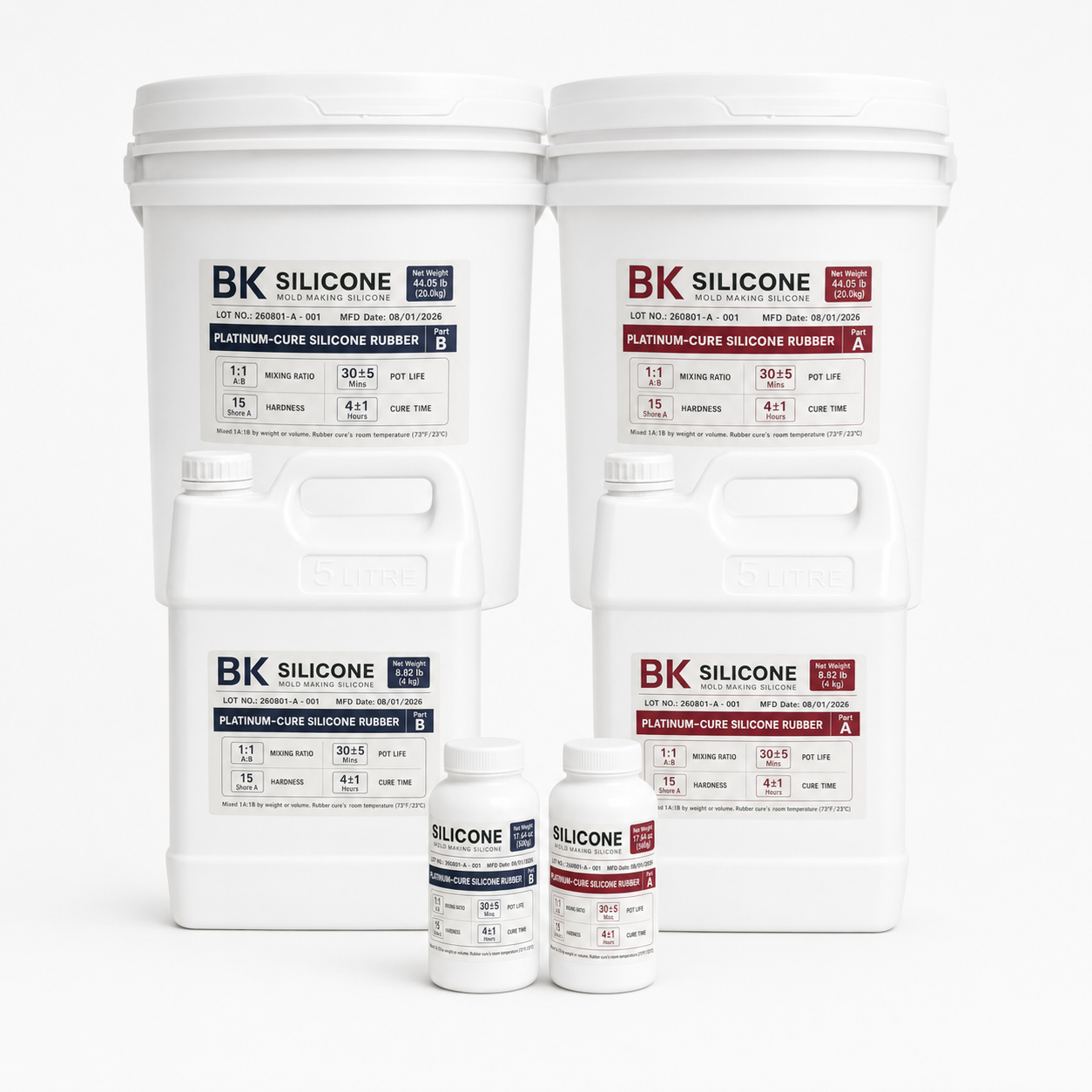
BK-A05
Start the BK-A05 review when the mold must flex more during release and the main risk comes from deeper undercuts, narrow openings, delicate details, or geometry that needs to roll back around a rigid casting.
- Release movement is more demanding than wall support.
- The cavity has moderate undercuts or a restricted opening.
- A fitted holder or support shell can control broad or tall walls.
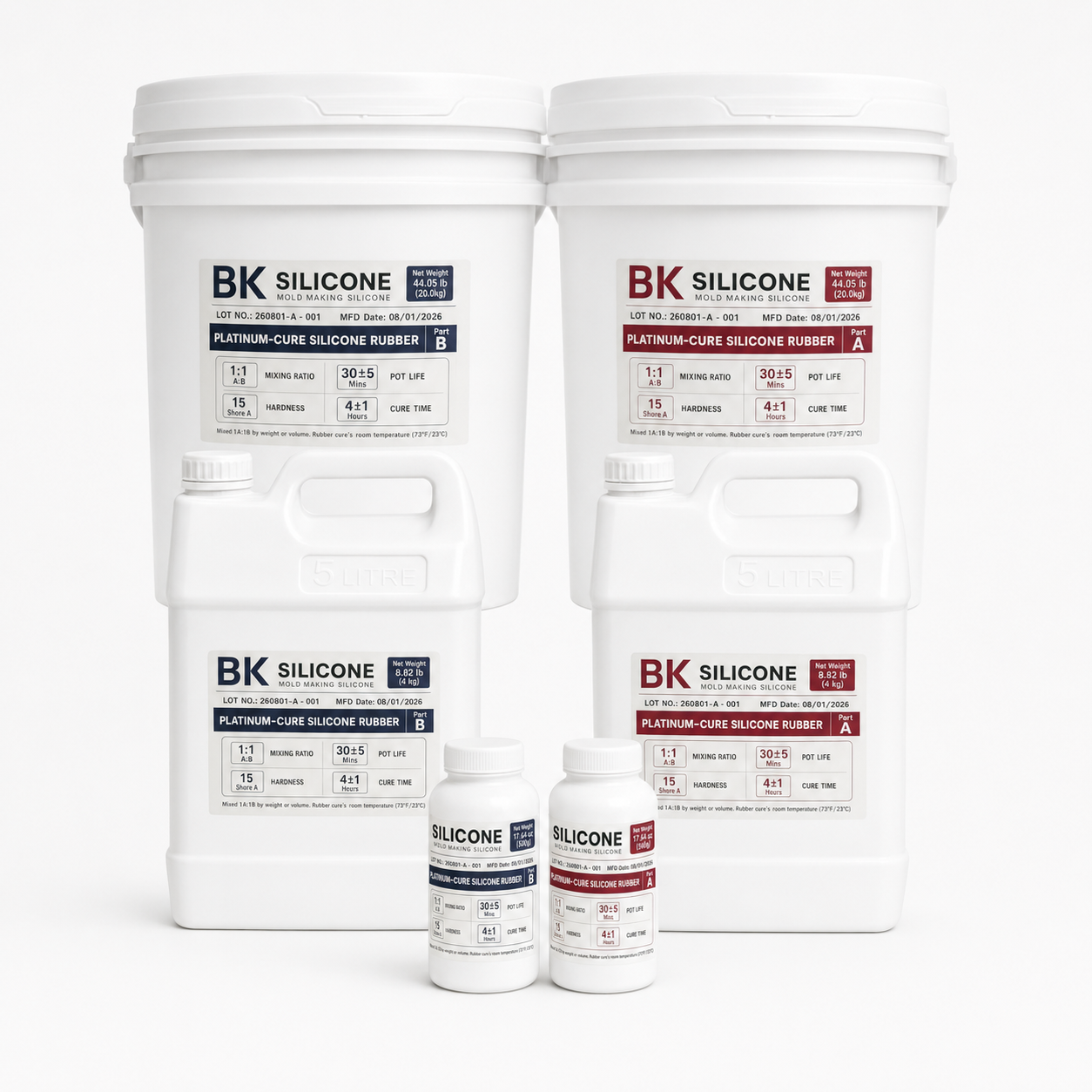
BK-A15
Start the BK-A15 review when cavity support, stable registration, heavier casting load, or repeatedly stressed edges matter more and the part can still be released without extreme stretching.
- Walls need more shape stability during casting.
- Openings or thin edges receive repeated handling stress.
- The release path is practical without excessive mold deformation.
Match the Validation Plan to the Production Goal
A concept mold and a repeat-production mold do not need the same level of evidence. Early development should answer the biggest technical risks quickly. Repeat production requires more attention to registration, handling, cleaning, dimensional checks, process records, and what changes after several release cycles.
Prototype Development
A small representative mold can confirm cure compatibility, detail filling, release direction, and casting surface without committing the entire master. One successful cast is not enough if the project is expected to move into repeated production. Include the highest-risk feature rather than choosing only an easy flat sample.
Small-Batch Production
Small batches need a practical balance between setup time and dependable output. The mold should be straightforward to fill, close, support, open, clean, and store. Several pours in one shift also increase the importance of contamination control, assembly consistency, and operator handling.
Repeated Production and Dimensional Control
Repeated demolding places more stress on thin edges, cuts, joints, and release openings. Stable registration and external support become more important as the cycle count rises. Avoid fixed mold-life promises unless the service-life statement is tied to a defined casting material, cleaning routine, geometry, and test method.
Dimensional consistency is a system result. Master accuracy, mold box, support shell, cure conditions, casting shrinkage, temperature, and measurement method all affect the finished part. A first-article approval should identify critical dimensions, visible defect limits, and acceptable release behavior.
Material Review or Custom Mold Development?
Choose a Material Review
This route fits an existing or already-defined mold design when the main task is to select or replace the silicone material.
- Wall thickness, openings, cuts, and parting lines are already known.
- The master and casting materials are defined.
- The support shell or holder already exists or has been designed.
- The goal is to compare a suitable BK-A grade through a representative trial.
Choose Custom Mold Development
This route fits a project where material behavior and mold construction still need to be designed as one system.
- Parting line, cut location, support shell, or release route is unresolved.
- The part contains severe undercuts, proprietary geometry, or critical dimensions.
- The project needs a mold built around a 3D file, drawing, or physical master.
- Handling, lifting, registration, or production layout needs engineering review.
Documentation and Compliance Review
A technical data sheet, safety data sheet, and test report answer different questions. The TDS supports grade and process review. The SDS supports handling and workplace safety. A test report applies only to the stated sample, method, conditions, and scope.
Do not treat one document as a substitute for another, and do not extend a general product statement to every finished application. Current grade-specific documents should be checked against the real process, intended use, and destination market.
Use the current TDS to compare grade-specific properties, mixing guidance, cure conditions, and processing information. Check those conditions against the real mold geometry and shop process.
Use the current SDS for handling, storage, protective measures, and workplace review. Local operating requirements may add further controls.
Check the tested sample, test method, conditions, revision, and stated scope. A report’s availability does not automatically confirm suitability for every market, temperature, contact condition, or finished product.
Application Selection Matrix
Use this matrix to identify the first technical question for each application. Each row should lead to a defined sample plan rather than an automatic grade choice.
| Application | Main requirement | Primary risk | Data to confirm | Suggested trial |
|---|---|---|---|---|
| Decorative candles | Flexible release with stable wall support | Tall-wall movement, additive interaction, tip tearing | Wax type, additives, pour conditions, cavity depth | Full-detail cast using the intended wax blend |
| Soap and logo molds | Clean transfer and stable tray handling | Additive effects, thin bridges, edge damage | Soap base, additives, cavity count, release method | Representative multi-cavity section |
| Resin casting | Detail capture with workable release | Cure inhibition, process heat, sticking, mechanical lock | Resin chemistry, additives, master coating, process conditions | Cure patch followed by a detailed casting sample |
| Plaster and gypsum | Complete edges and reliable support | Fragile corners, trapped air, wall movement | Mix, part weight, detail depth, handling routine | Representative cast with edge inspection |
| Concrete and cement | Load support with manageable release | Aggregate wear, deformation, thin-detail damage | Mix design, aggregate size, part mass, vibration | Critical section using the production mix |
| Food-contact articles | Grade-specific document review | Unsupported compliance assumptions | Food type, contact time, temperature, market, cleaning | Document review followed by process validation |
| Fine-detail replication | Fine filling with protected release edges | Narrow grooves, undercuts, trapped air | Feature size, undercut depth, master finish, release route | Detail coupon plus one complete mold trial |
RFQ Checklist: What to Send Before Asking for a Grade
A useful material recommendation depends on complete project information. Photographs are helpful, but they rarely show hidden undercuts, exact dimensions, coating chemistry, process heat, or the expected casting load. Send both the mold geometry and the real production conditions.
Casting Material
State the exact casting medium and chemistry when available. Include pigments, fillers, fragrances, hardeners, release agents, aggregate, and other additives. Add process temperature or noticeable exotherm if relevant.
Finished Master
Identify the base material and every contact layer. Primers, paints, fillers, adhesives, sealers, repair compounds, and release coatings can change compatibility.
Dimensions and Geometry
Provide overall size, cavity depth, narrowest opening, critical feature dimensions, undercuts, reverse tapers, thin edges, channels, and proposed parting lines. Include expected casting weight for larger parts.
Mold Format and Support
State whether the plan is one-piece, cut, two-part, multi-part, skin, or shell-supported. Describe the holder, cradle, mother mold, fastening method, pour direction, and lifting limits if already known.
Production Target
Provide prototype quantity, initial batch size, expected ongoing output, and cycle rhythm. This information helps determine how much repeated demolding and cleaning should be included in validation.
Process Conditions
List room, material, tool, and casting temperatures where relevant. Describe humidity control, ventilation, storage, cleaning, and whether mixing or pouring occurs in a shared silicone workspace.
Contact Requirements
State whether the mold will contact food, skin, industrial chemicals, or another controlled medium. Include destination market, use temperature, contact time, repeated-use condition, and cleaning method.
Available Equipment
Describe weighing accuracy, mixing tools, vacuum degassing, pressure equipment, ovens, transfer equipment, and support fixtures so the recommendation reflects the real process.
Quality Targets
Define surface finish, visible defect limits, critical dimensions, acceptable release behavior, and the failure mode that matters most to the project.
Requested Documents
Request the current TDS, SDS, and relevant existing test information for the proposed grade. Confirm document revision and scope before relying on the information for production approval.
Frequently Asked Questions
What applications are best for platinum silicone molds?
Platinum-cure silicone is commonly reviewed for detailed candle, soap, resin, plaster, concrete, food-contact, and decorative replication molds. The application name alone is not enough to approve a grade. Master chemistry, casting conditions, geometry, support, release route, and documentation requirements still need to be defined.
How should I choose between BK-A05 and BK-A15?
Use BK-A05 as the first test direction when the mold needs greater release movement around moderate undercuts or a narrow opening. Use BK-A15 as the first direction when wall stability, casting load, registration, or repeatedly stressed edges matter more and the release path does not require extreme stretching. A representative trial should make the final decision.
Can platinum silicone be used with 3D-printed resin masters?
It can be evaluated with properly processed resin masters, but printed parts may retain uncured compounds or surface residues. The relevant washing, post-curing, sanding, priming, sealing, and final coating process should be completed before a test patch is used to confirm compatibility.
What usually causes cure inhibition?
Potential causes include sulfur-containing materials, natural latex, tin-cure silicone residue, some reactive additives, incompletely processed printing resins, and unknown coatings. Contaminated tools, gloves, benches, or porous surfaces can also transfer inhibitors.
Is hardness the main number to compare when choosing mold-making silicone?
No. Hardness affects flexibility and shape retention, but the decision also depends on viscosity, tear behavior, wall thickness, casting weight, opening size, undercuts, support method, and the planned release route. Start with the failure risk and use the material properties to solve that specific problem.
What should I send for a useful material recommendation?
Send casting chemistry, finished-master material and coatings, overall dimensions, cavity depth, undercuts, mold format, support method, expected production volume, process conditions, contact requirements, available equipment, and the most important quality target. Current documents and a representative sample can then be matched to the real project.
Before Ordering, Confirm These Three Things
- Material compatibility: test the final master surface and the intended casting formulation, including relevant additives and release products.
- Mold mechanics: record dimensions, undercuts, thin features, release opening, parting concept, wall support, and expected casting load.
- Production evidence: review current technical documents and run a representative cure-and-casting trial that includes the highest-risk feature before scale-up.
Request a Grade and Sample Review
A useful recommendation starts with the real project rather than a generic material label. Send the casting medium, finished master, dimensions, cavity depth, undercuts, mold format, support method, expected output, process conditions, contact requirements, and available equipment. That information allows the first BK-A sample direction and validation scope to be matched to the mold you actually plan to produce.
- Casting material, additives, and process heat
- Master material, coatings, and cure status
- Dimensions, undercuts, openings, and support method
- Production volume, equipment, and quality targets